
Most kitesurf trips to Ceará start the same way: you land in Fortaleza, turn left towards Cumbuco and Jericoacoara, and share the water with hundreds of other kites. Yet the coast that runs south-east of Fortaleza gets the same trade winds, the same warm water and the same endless beaches, with a fraction of the crowds. If you are wondering where to kitesurf south of Fortaleza, this guide walks you through the spots worth knowing, what each one is good for, and why so many riders end up staying in Parajuru.
Why look south of Fortaleza instead of west?
The famous « west coast » of Ceará (Cumbuco, Taíba, Paracuru, Preá, Jericoacoara) built its reputation over twenty years. That success has a price: busy launch areas, crowded lagoons in high season and prices that keep climbing. The east coast, often called the Costa do Sol Nascente, has remained a coast of fishing villages, red cliffs and quiet beaches.
For kitesurfers, the conditions are just as good:
- The same trade winds: the east and south-east trades blow almost every day from July to January.
- Warm water all year: around 26 to 28 °C, so a lycra is enough, no wetsuit needed.
- Sandbanks and lagoons: the shoreline forms shallow flat-water areas, with small waves breaking further out on the sandbars.
- Space: on many days you share a whole beach with a handful of kites.
The best kitesurf spots south of Fortaleza
Here are the spots you will come across as you drive down the CE-040 coastal road, from Fortaleza towards the border with Rio Grande do Norte. Distances are approximate, by road from Fortaleza airport.
Morro Branco and Praia das Fontes (about 85 to 95 km)
Famous for their coloured sand cliffs and labyrinths, these two beaches of Beberibe are more of a sightseeing stop than a kite destination. The beaches are busier with day tourists and the conditions are less forgiving for beginners. Worth a visit on a no-wind day.
Parajuru (about 130 km)
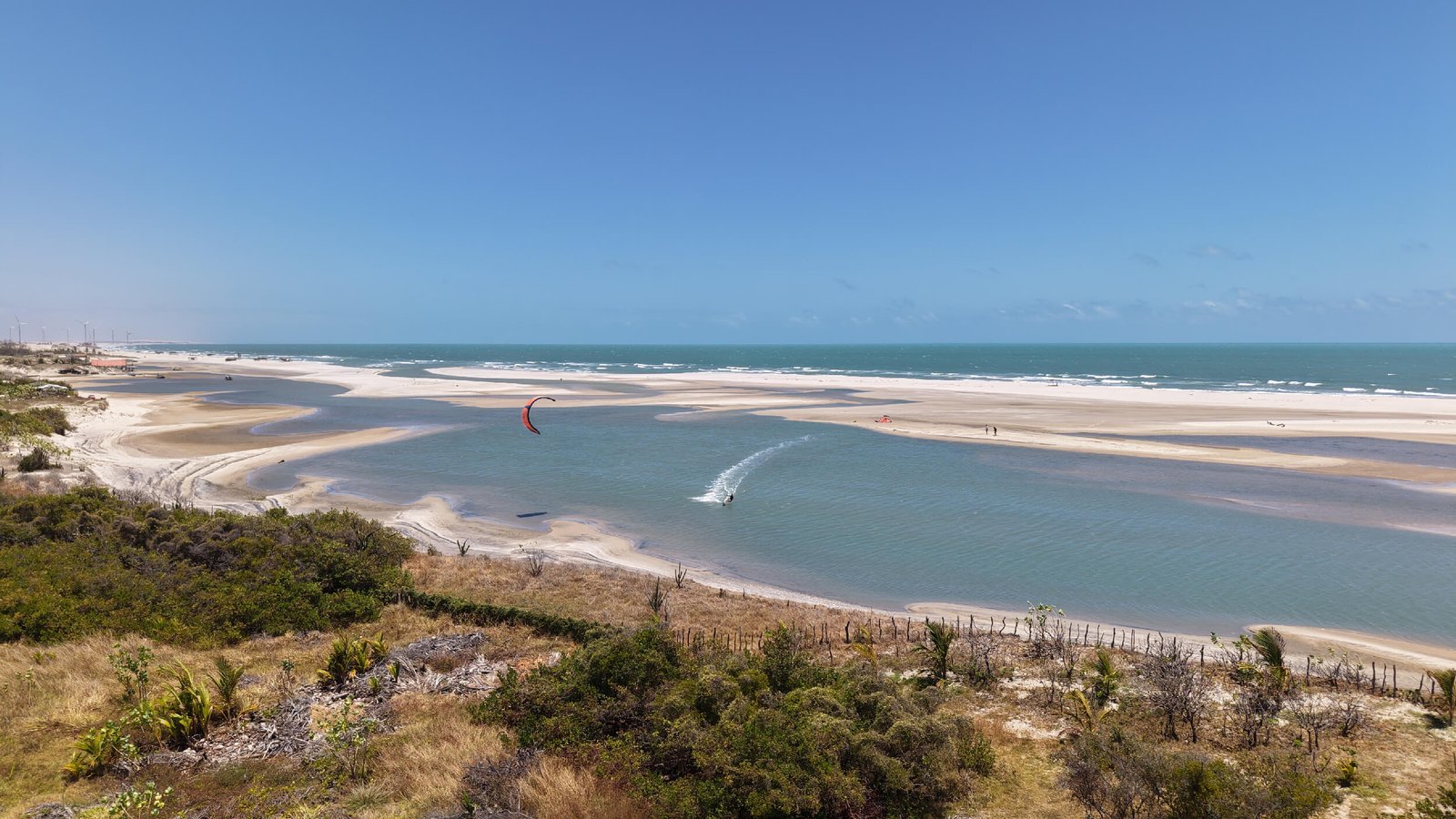
A small fishing village in the municipality of Beberibe, where jangadas still go out every morning. Parajuru offers one long open beach where the sandbanks create shallow, flat-water lagoons at high tide, close to shore, and small waves on the outer sandbar for riders who want them. The wind is usually cross-shore in the morning, turns side-onshore in the afternoon and is often strongest in the late afternoon, right up to sunset. We cover it in detail below.
Fortim and Pontal de Maceió (about 150 km)
At the mouth of the Jaguaribe river, Fortim mixes river, mangroves and open beach. It is a nice spot for experienced riders and a classic starting point for downwinders towards Parajuru. Currents around the river mouth mean it is better discovered with someone who knows the area.
Canoa Quebrada (about 165 km)
The red cliffs of Canoa Quebrada are one of the postcard images of Ceará. The village is lively, with restaurants, bars and paragliding over the cliffs. On the water you get more waves and more chop, which suits intermediate and advanced riders more than beginners.
Further south: discover the lesser-known kite spots of Rio Grande do Norte
If you have a little more time to explore, the coast does not stop being interesting at the Ceará border. Further south, in the neighbouring state of Rio Grande do Norte, places like Galinhos, Guamaré and Soledade offer fascinating settings for kitesurfing, with wide-open spaces, local fishing communities and spots that remain far less familiar to international kite travellers.
We will explore these destinations in more detail in future guides, but they are well worth keeping on your radar if you are planning a longer kite trip.
Back in Ceará, the Rota das Falésias, the coastal route known for its dramatic red cliffs, traditional villages and beautiful beaches, is still a part of the region waiting to be discovered by many visitors. Beyond the better-known destinations, you will find a quieter side of the Brazilian coast, where local life remains part of the experience and the beaches offer plenty of room to enjoy the wind.
If you are looking for more than just another famous kite spot, this stretch of coastline is well worth exploring.
Why Parajuru is the best base on the east coast of Ceará
All these spots are worth a session, but if you want one place to stay for a week or two and kite every day, Parajuru ticks the most boxes.
1. Flat water right in front of the beach
You do not need a 4×4 or a long drive to reach a lagoon. In Parajuru the sandbanks create shallow, flat lagoons right on the beach. They fill at high tide, and you can stand almost everywhere, which is ideal for learning the water start, practising transitions or landing your first jumps. Further out, the sandbar offers small, clean waves when you want to play.
2. Wind you can plan around
he kitesurfing season in Parajuru runs from July to January, with September, October and November offering the most reliable wind conditions. During these months, the trade winds are particularly consistent, making it easier to plan a kite trip and maximise your time on the water.
July and August mark the build-up to the strongest part of the season, while December and January can still offer plenty of good sessions, although the wind may become less consistent.
With warm water, open beaches and plenty of space to ride, Parajuru is a great destination throughout the season, whether you are looking to learn, progress or simply enjoy long days on the water.
3. No crowds
This is the main difference with Cumbuco or Jericoacoara. In Parajuru you often share the water with only a handful of kites. For a beginner it means more space and less stress. For an advanced rider, it means you can practise tricks without worrying about who is downwind.
4. A real village, not a kite resort
Parajuru is a fishing village with grilled lobster on the beach, jangadas at sunset and a slow rhythm. You come for the wind, and you stay for the atmosphere.
Parajuru vs Cumbuco vs Jericoacoara: which one is right for you?
If you are looking for an alternative to Jericoacoara for kitesurfing, here is how the three compare.
| Parajuru | Cumbuco | Jericoacoara | |
|---|---|---|---|
| Distance from Fortaleza | About 130 km, 1h40 to 2h | About 35 km, 45 min | About 300 km, 4h to 5h |
| Water | Flat water on the beach, small waves on the sandbar | Choppy sea, flat water in nearby lagoons (Cauípe) | Waves and chop at the main beach, lagoons nearby |
| Crowd in high season | Very low | High | High |
| Atmosphere | Quiet fishing village | Kite town, shops and nightlife | Touristic village, nightlife |
| Best for | Learning, progressing, freestyle, calm | Social trips, short stays | Experienced riders, downwinders |
In short: choose Cumbuco if you want a lively kite town close to the airport, Jericoacoara if you want the legend and the nightlife, and Parajuru if you want space, flat water and time on the water.
When to go kitesurfing south of Fortaleza
The main wind season on the whole Ceará coast runs from July to January. From February to June the wind is lighter and less regular (roughly 8 to 16 knots) and it is the rainy season, but good days still happen. If kitesurfing is the main goal of your trip, plan it between July and January, ideally between August and November. For a full planning guide, read our article on how to organise your kitesurf trip to Parajuru.
Learning or progressing? Where to start in Parajuru
Parajuru is one of the best places in Brazil to learn kitesurfing: shallow water, steady wind and few people around. At Caju Knots, Priscilla and Xavier are both IKO-certified instructors and teach in very small numbers, often one instructor for one rider. If you already ride, we also arrange supervised sessions, gear rental and downwinders. Find out why Parajuru is the perfect spot to progress in kitesurfing, or check our lesson and rental prices.
Frequently asked questions
What is the best kitesurf spot south of Fortaleza?
For a stay of several days, Parajuru is the most complete spot on the east coast: flat water on the beach, small waves on the sandbar, consistent wind from July to January and very few kites. Fortim and Canoa Quebrada are great day trips.
How far is Parajuru from Fortaleza?
About 130 km south-east of Fortaleza airport, which is around 1h40 to 2 hours by car on the CE-040 coastal road.
Is the east coast of Ceará good for beginners?
Yes, especially Parajuru, thanks to its shallow flat water and uncrowded beach. Spots with more waves, like Canoa Quebrada, are better suited to intermediate riders.
Is Parajuru a good alternative to Jericoacoara?
If you are looking for flat water, space and a quiet village rather than nightlife, yes. It is also much closer to Fortaleza, so you spend less time on the road and more time on the water.
Plan your kite stay in Parajuru
Caju Knots is a small kite and yoga house in Parajuru, with two garden chalés and a villa with a pool, a few minutes from the spot. Tell us your dates and your level, and we will help you plan the week around the wind. Contact us.